
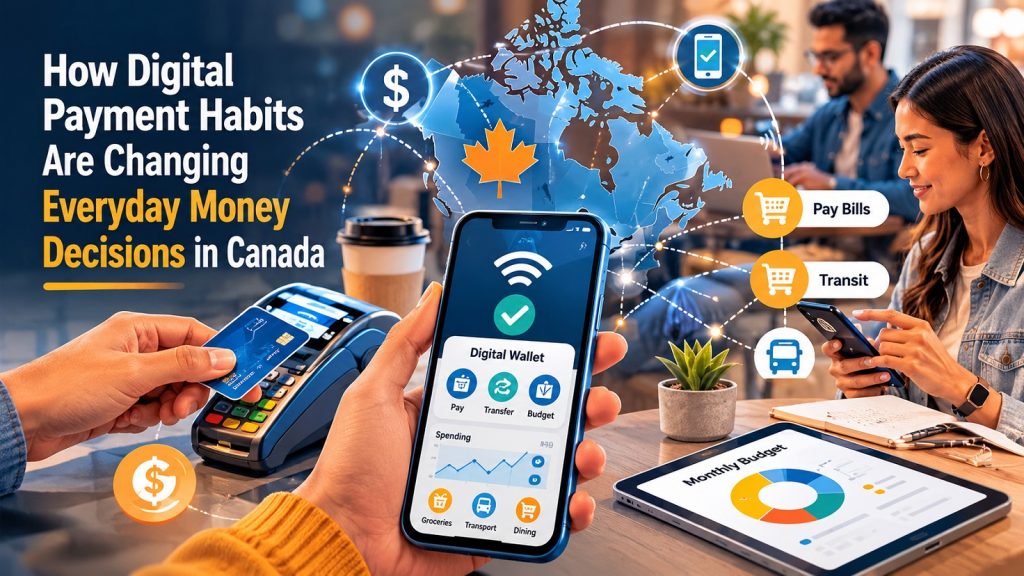
Walk through any Tim Hortons in Toronto, Vancouver, or Halifax and you will see the same thing: phones tapped on terminals, watches held to readers, debit cards barely making it out of wallets. Canada has quietly become one of the most digital-first payment markets in the world, and the way people decide what to spend on, when to spend, and how much to commit has shifted with it. The numbers from the Bank of Canada’s research on digital payments tell a clear story: cash use has been falling for over a decade, contactless transactions dominate everyday retail, and account-to-account payments now feel native to a generation that has never written a cheque.
That shift is not just about convenience. It is changing the psychology of money for millions of Canadians, and nowhere is the effect more visible than in discretionary categories like streaming, food delivery, micro-investing, and online gambling.
From Physical Wallets to Phone-First Decisions
The defining feature of modern Canadian payments is speed. Interac e-Transfer settles in minutes. Tap-to-pay clears in under a second. Mobile wallets like Apple Pay and Google Pay have folded multiple cards into a single biometric confirmation. When a payment takes one second instead of ninety, the friction that used to slow people down disappears, along with the natural pause that came with counting out bills.
That has two consequences. First, Canadians make more small purchases per week than they did a decade ago, even when their overall spending stays flat. Second, larger one-off decisions are made on impulse far more often. The path from interest to purchase has collapsed from days to seconds.
Why Bank-Linked Rails Became a Canadian Habit
Credit cards still carry the lion’s share of online transaction volume, but Canadians have built a strong preference for paying directly from a chequing account. Part of that is cultural, since household debt levels are a constant topic in Canadian media and consumers increasingly want to “feel” the money leaving the account in real time. Part of it is practical, because account-to-account services bypass the foreign exchange fees, credit limits, and merchant restrictions that come with cards.
This is the gap that services like Instadebit and iDebit fill. They sit between a player’s Canadian bank account and a merchant, push funds in real time, and never expose card details to the receiving site. For online entertainment in particular, including the best online casinos in Canada, this rail has become a default option because it keeps the deposit limit tied to what is actually in the account rather than what a credit line will tolerate.
How Payment Habits Cross Over Into Entertainment Spending
The everyday habit of tapping a phone for coffee carries directly into how Canadians fund online entertainment. Three patterns are worth watching.
- Smaller, more frequent deposits. Players who once deposited $100 once a month now top up $20 a few times a week. It feels lighter even when the total is the same.
- Mobile-first sessions. The phone has overtaken the laptop as the primary device for online play. Operators have responded by rebuilding their interfaces around vertical screens and biometric login, a shift we covered when looking at how mobile casinos have changed the player experience.
- Stricter mental budgeting. Because account-linked payments show the balance instantly, players are more likely to set a hard cap and stop when they hit it. That is good news for responsible play.
One-Tap Spending Demands One-Tap Discipline
The same speed that makes digital payments convenient can erase the buffer between “I am thinking about it” and “I just did it.” For categories like online gambling, where a single confirmation can move real money in seconds, the only durable defence is a system, not willpower. Canadian banks now offer transaction blocks, daily limits, and category-level controls; most reputable operators offer deposit caps and time-out tools that match. Pairing the two is the modern equivalent of leaving cash at home.
Practical money management still matters, and habits that work offline carry over directly. Setting a session budget before opening an app, tracking weekly outflow rather than per-deposit amounts, and treating bonuses as marketing rather than free money all map onto the same logic that financial planners give any household. We laid out the core habits in our guide to managing money at online casinos, and they translate cleanly to anyone trying to keep digital spending under control.
The Takeaway
Digital payment habits in Canada have not just changed how people pay, they have changed how people decide. Faster rails mean lower friction, lower friction means more frequent micro-decisions, and that pattern shows up everywhere from grocery runs to entertainment budgets. The Canadians who adapt best are the ones who match the speed of their wallet with the speed of their guardrails, which is the same principle behind responsible gambling: the tools have to move at least as fast as the temptation.